Do Budget Instant-Read Thermometers Actually Work?
Editorial desk · 9 min read · Updated 2026-08-23
A budget instant-read thermometer, generally in the $10-to-20 range, can be just as reliable for food safety as a premium model costing $70 or more. The real differences between the two price tiers are response time and accuracy tolerance, not a hard line between "safe" and "unsafe." What actually matters most, regardless of price, is testing a specific thermometer's real-world accuracy yourself rather than assuming the number on the price tag settles the question.
This is genuinely useful to know if a working thermometer feels like an unnecessary expense on top of everything else a kitchen needs, since the food-safety value a thermometer provides doesn't require the most expensive option on the shelf to be real and meaningful.
| Response time | Accuracy tolerance | NIST-traceable calibration available | |
|---|---|---|---|
| Budget ($10-20) | 2-3 seconds | ±1-2°F | Yes |
| Premium ($40-100+) | Under 1 second | ±0.5-0.9°F | Yes |
What actually separates budget from premium
Budget instant-read thermometers commonly land in the $10-to-20 range, while premium models, the kind professional kitchens and serious home cooks often reach for, run anywhere from $40 to $100 or more. The gap between them mostly comes down to two measurable specs: response time and accuracy tolerance.
Response time is how quickly the thermometer settles on a stable reading once the probe is inserted. Budget units commonly take 2 to 3 seconds; premium units often claim under a second. Accuracy tolerance is how far off a reading might be from the true temperature: budget models commonly spec around plus or minus 1 to 2 degrees Fahrenheit, while premium models often spec closer to plus or minus 0.5 to 0.9 degrees. Both differences are real, but neither one makes a budget thermometer fundamentally unfit for confirming whether food has reached a safe temperature.
Display type and probe design account for most of the rest of the price gap, and neither affects accuracy directly. A backlit display, a folding probe versus a fixed one, a magnetic back for storing the unit on a fridge or oven door, and a waterproof housing all add convenience and, often, cost, without changing whether the sensor itself reads temperature correctly. A bare-bones budget model with none of these features can still be exactly as accurate as a premium one loaded with all of them, which is worth remembering if a specific product's price seems to be driven more by extras than by the core measurement the thermometer actually exists to make.
Why a couple of seconds and a degree or two rarely matters for safety
A 2-to-3-second response time versus a sub-second one matters more for convenience and workflow, checking many pieces quickly in a busy professional kitchen, than it does for whether a single home-cooked meal is actually safe. As long as you hold the probe in place long enough for the reading to fully stabilize, rather than pulling it the instant a number first appears, a budget thermometer's slightly slower response time doesn't compromise the accuracy of the final reading.
The accuracy tolerance gap matters more in specific situations than in general home cooking. A degree or two of uncertainty is largely irrelevant when a target temperature has real margin built in, like resting brisket or pork butt well past 195°F. It matters more right at a hard safety line, like confirming meatloaf has reached 160°F or pork tenderloin has reached exactly 145°F, where a thermometer reading a couple of degrees high could show a passing number on meat that hasn't actually cleared the real threshold. Confirming pork tenderloin is genuinely done is a case worth naming specifically, since it's one of the few cuts where a thin margin, and a lingering pink color that's actually safe, makes cooks second-guess an accurate reading rather than trust it.
NIST-traceable calibration isn't a premium-only feature
It's a reasonable assumption that NIST-traceable calibration, meaning a thermometer's accuracy has been verified against a recognized national standard, is something only premium models offer. That assumption doesn't hold up: NIST-traceable calibration certificates are available across both budget and premium price tiers in the current market, which means price alone isn't a reliable signal of whether a specific thermometer has been calibrated against a real standard. Checking a specific product's listed specs and included documentation is a more useful step than assuming a higher price automatically means better-verified accuracy.
NIST traceability specifically means the thermometer's stated accuracy has been checked against reference instruments that trace back, through an unbroken chain of comparisons, to the National Institute of Standards and Technology's own standards. That's a meaningful claim for a lab thermometer used in a regulated setting, where a certificate might genuinely need to be produced on request. For a home kitchen, it's a nice-to-have rather than a requirement, since the far more practical check, a direct ice-water or boiling-water test on the specific unit in your hand, tells you what you actually need to know without requiring any paperwork at all. A thermometer that passes your own test is doing its job whether or not a certificate came in the box.
Manual recalibration is a separate feature worth checking for, independent of both price and NIST claims. Many dial thermometers, and a smaller number of digital ones, include a small nut or reset button that lets you adjust the reading to match a known reference point, typically the ice-water test's 32°F. A thermometer without this feature that drifts out of accuracy over time generally needs replacing rather than fixing, which is worth factoring in for a unit you expect to rely on for years rather than one or two seasons.
Testing any thermometer yourself, regardless of price
The most reliable way to know whether your specific thermometer is accurate isn't the price you paid; it's testing it directly. The ice-water test is the simplest method: fill a glass with crushed ice, add water, insert the probe at least two inches deep without touching the glass, wait about 30 seconds, and check that it reads 32°F. A reading within a degree or two of that number is generally considered acceptable; a bigger gap suggests the thermometer needs recalibrating, if it has that feature, or replacing if it doesn't.
A boiling-water test works as a second check: bring water to a full rolling boil, insert the probe at least two inches deep without touching the pot itself, wait about 30 seconds, and check for 212°F at sea level. Altitude changes this expected number, since water boils at a progressively lower temperature at higher elevations, so anyone testing this way above sea level needs to adjust their expected reading accordingly rather than assuming 212°F applies everywhere.
Running both tests rather than just one is worth the extra couple of minutes, since a thermometer can occasionally read accurately at one end of the temperature scale while drifting at the other. The ice-water test checks accuracy near freezing; the boiling-water test checks it near the opposite extreme, and food safety checks generally fall somewhere in between the two, closer to the boiling end for most meat targets. A thermometer confirmed accurate at both ends gives more confidence across the actual range you'll use it for than a single test at either extreme alone.
Running one or both of these tests periodically, particularly after a thermometer has been dropped or used heavily over time, matters more for long-term reliability than the initial purchase price does. A budget thermometer tested and confirmed accurate is a more trustworthy tool than an expensive one that's never been checked and may have drifted out of calibration.
Probe thickness affects accuracy on thin cuts
One functional difference worth paying attention to, regardless of price tier, is probe thickness. A thicker probe tip can struggle to fully seat inside a thin piece of meat, like a chicken breast or a burger patty, without the tip partially poking through the far side, which can produce a misleading reading that reflects ambient air temperature rather than the meat's true internal temperature. A thinner probe generally handles this situation more gracefully, since it's easier to fully bury the sensing tip within a thinner cut.
This matters more for foods like thin chicken cutlets or burger patties than it does for something thick like a whole brisket, where probe thickness has little practical effect since there's plenty of material for even a thicker probe to sit fully inside. A brisket does raise a different challenge for probe placement, though: its two component muscles don't heat at exactly the same rate, so a single reading taken only in the flat can miss how far along the fattier point actually is, and vice versa. Checking more than one spot matters more on an oddly shaped, multi-muscle cut like a whole brisket than it does on a uniform piece of meat, regardless of which thermometer is doing the checking.
Probe length is a related spec worth a quick mention alongside thickness. A short probe, common on some compact budget models, can struggle to reach the center of something as thick as a whole brisket or a large roast without the display end getting uncomfortably close to a hot grate or oven wall. A probe in the four-to-five-inch range handles most home cooking, brisket included, without that problem, while anything shorter is better suited to thinner, smaller cuts where reaching the center never requires much depth to begin with.
Where a premium thermometer genuinely earns its price
None of this means premium thermometers are pointless. Faster response time is a real, tangible benefit for anyone checking many pieces of food in quick succession, a professional kitchen environment, a big holiday cooking day with multiple dishes needing checks close together, or simply a cook who values not waiting several seconds per reading. Tighter accuracy tolerance also provides genuine peace of mind right at critical safety thresholds, even if a couple of degrees of variance rarely changes the practical outcome for most home cooking.
The honest tradeoff is convenience and a small margin of extra precision, purchased at a meaningfully higher price, rather than a fundamental gap in whether the food-safety job gets done. For a home cook checking a handful of dishes a few times a week, that premium convenience may or may not be worth the cost difference; for someone cooking at higher volume or right at tighter safety margins more often, it's an easier case to make.
What actually matters when choosing one
Response time, accuracy tolerance, and probe thickness are the three specs worth checking on any instant-read thermometer, budget or premium, rather than treating price as a reliable proxy for quality on its own. A thermometer that reads within a couple of seconds, holds a reasonable accuracy tolerance, and has a probe thin enough to work well on the foods you actually cook most often will do the job regardless of which price tier it falls into.
Testing whatever thermometer you already own, or are considering buying, with a simple ice-water check takes less than a minute and tells you more about its real-world reliability than its price tag ever could. A working, verified-accurate thermometer, at any price point, is the actual tool doing the food-safety work; everything else is a matter of convenience and how much of that convenience is worth paying for.
Put the price tag aside, run the test, and trust the number that comes back. That's the whole method, and it applies equally to a $12 unit pulled from a kitchen drawer and a $90 one still in its box.
Frequently asked questions
Is a cheap instant-read thermometer accurate enough for food safety?+−
Often, yes. A budget thermometer's accuracy tolerance is usually a little wider than a premium model's, but the more important factor is confirming any specific unit's actual accuracy yourself with a simple ice-water test, regardless of its price.
What's the real difference between a $15 thermometer and a $70 one?+−
Mainly response time and accuracy tolerance. Premium models commonly read in under a second with a tighter accuracy spec, while budget models take a few seconds longer and allow a slightly wider margin of error, though both categories can be genuinely reliable.
How do I test whether my thermometer is accurate?+−
Submerge the probe at least two inches into a glass of ice water; it should read 32°F after about 30 seconds. A boiling-water test at 212°F works too, adjusted for altitude, since water boils at a lower temperature at higher elevations.
Does a thicker probe matter for accuracy?+−
Yes, particularly on thin cuts of meat. A thick probe tip can struggle to fully seat inside something like a chicken breast or a burger patty without poking through the other side, which can produce a misleading reading regardless of the thermometer's other specs.
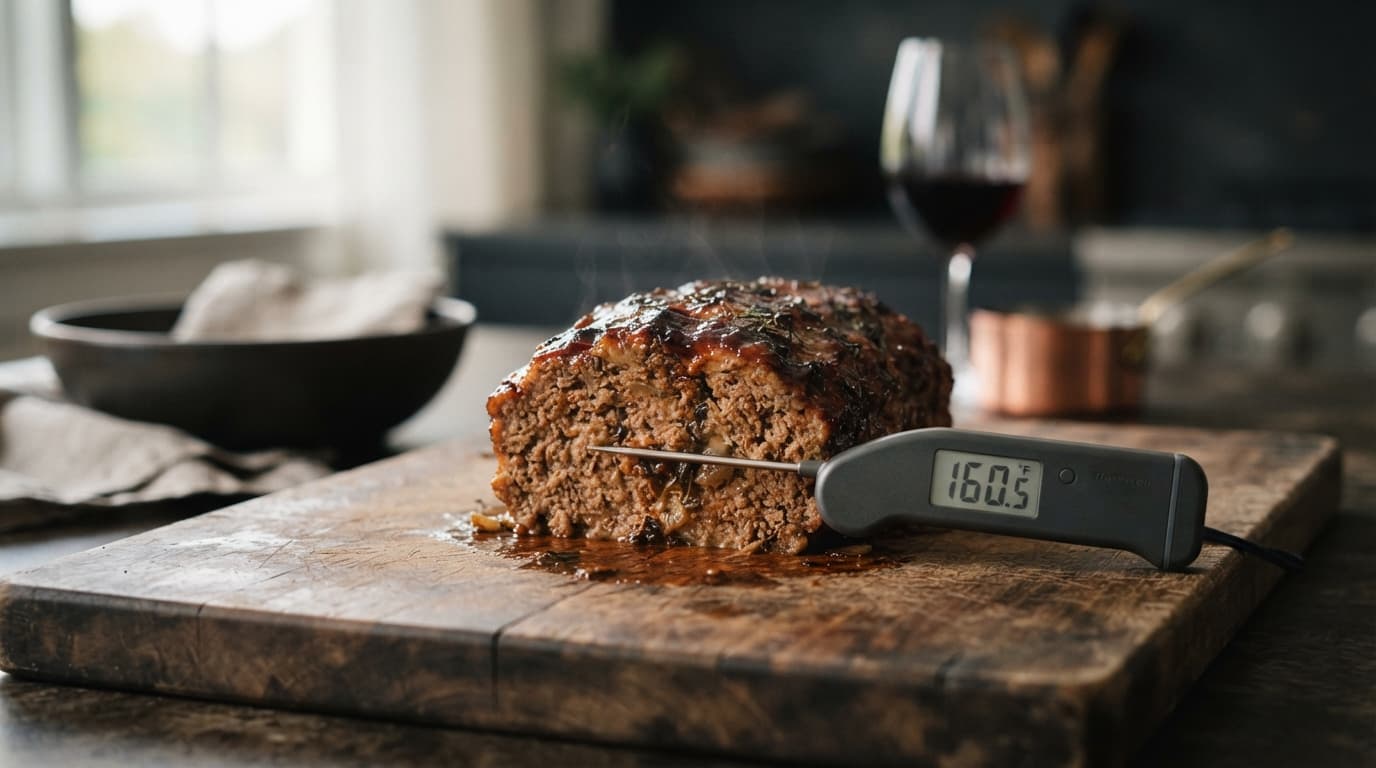
160°F, per USDA guidance for ground meat, beef, pork, veal, or a mix. That's higher than whole-cut beef's 145°F minimum, for a specific reason.
9 min read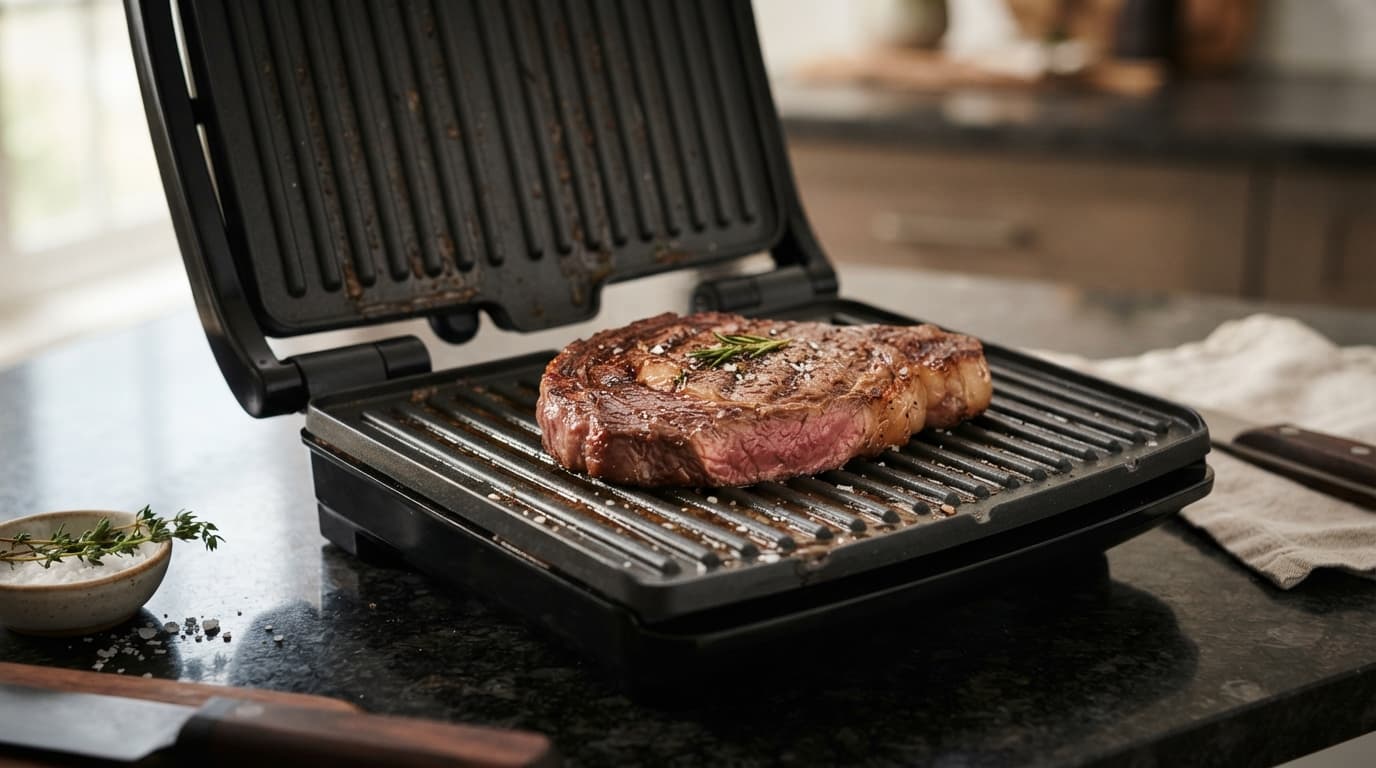
A 1-inch steak takes about 4-7 minutes for medium-rare on a contact grill, since both sides cook at once. Thickness affects time more than the clock does. Confirm 145°F.
10 min read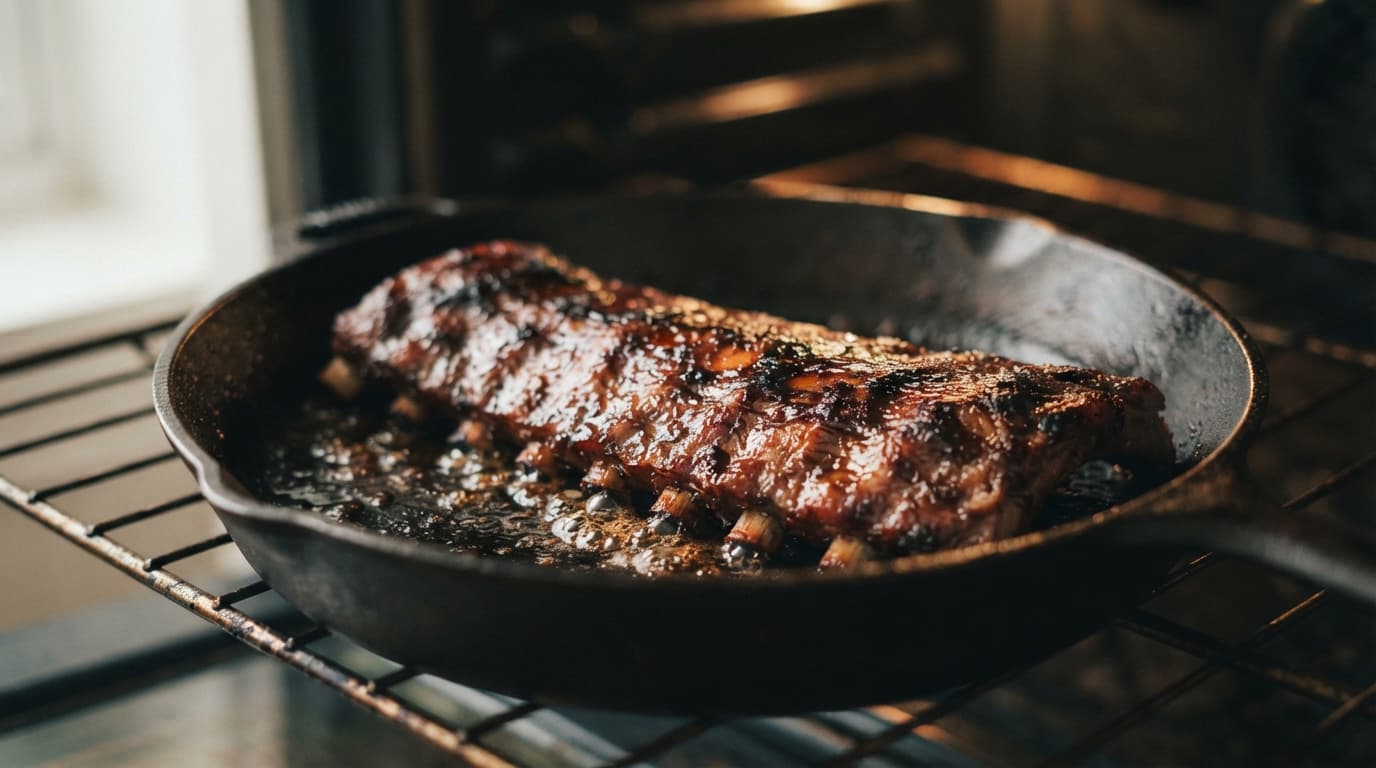
Precooked ribs need reheating to 165°F, not cooking from raw. The practitioner approach is about 250°F for 20 to 30 minutes, foil-wrapped with added moisture.
9 min readTables release two weeks out on Resy, Shukette's own booking platform.
Book Now →