What Temperature Is a Simmer on the Stove?
Editorial desk · 9 min read · Updated 2026-08-23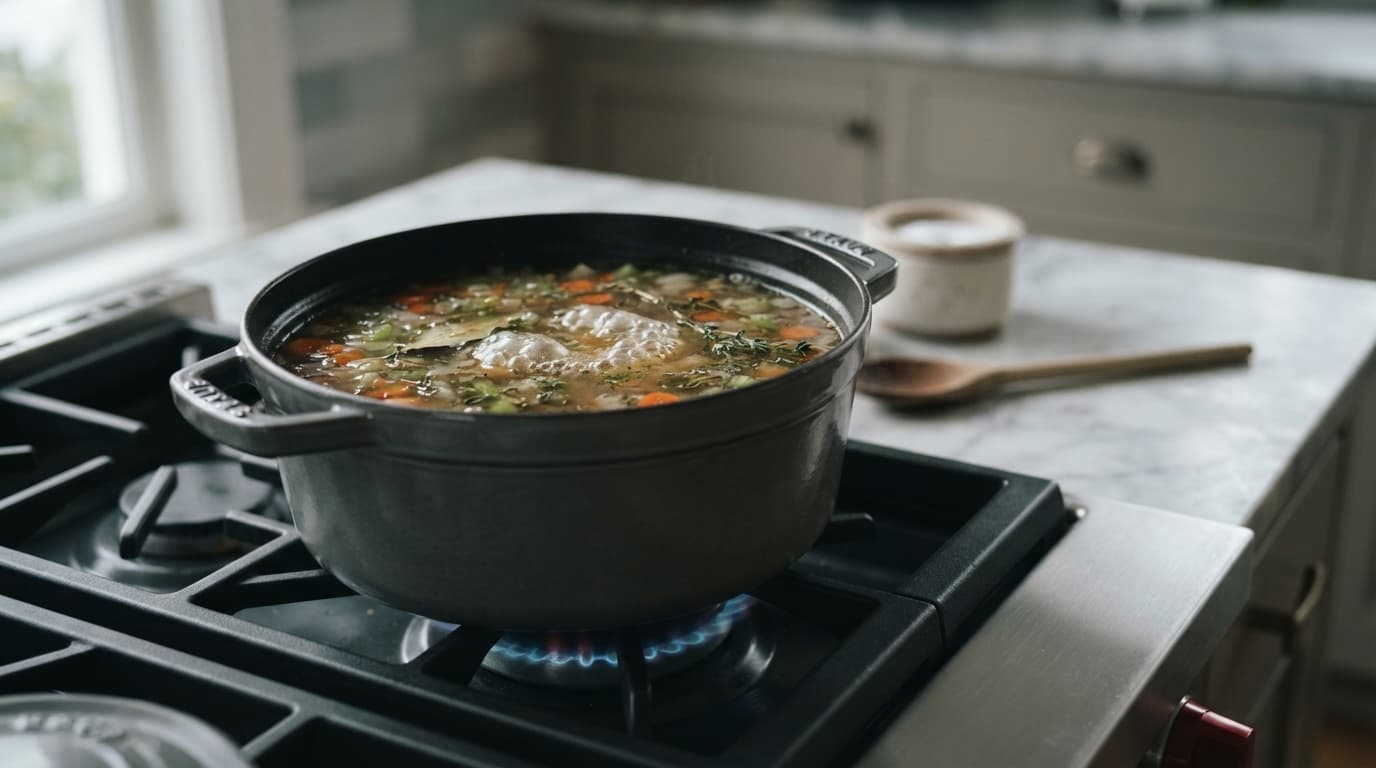
A simmer sits roughly between 185°F and 205°F, well below the 212°F mark where water actually boils at sea level. A gentle simmer runs closer to the 185°F end; a rapid simmer creeps up near 205°F, just shy of a full boil. You don't need a thermometer to hit it, either — the bubble pattern tells you almost everything you need to know once you've learned to read it.
That range comes from culinary-education consensus, not a government-issued number the way food-safety temperatures are. Cooking schools and reference sources generally agree on it, and once you've watched water cross from a simmer into a boil a few times, you'll recognize the difference on sight, no thermometer required.
How a simmer compares to a boil and a poach
Three stovetop heat levels come up constantly in recipes, and they're easy to mix up if you've only ever cooked by dial position instead of by what's actually happening in the pot.
A full boil hits 212°F at sea level, the point where water converts to steam fast enough to produce large, vigorous, rolling bubbles that constantly break the surface. It's loud, it splashes, and it moves food around inside the pot with real force.
A simmer runs 185-205°F, noticeably calmer. Small, steady bubbles break the surface regularly, but there's none of a boil's violent churn or heavy steam.
A poach is gentler still, roughly 160-180°F. At that range you'll see the occasional lazy bubble rise, sometimes none at all, just a faint shimmer on the surface. Poaching is reserved for the most delicate foods, eggs, fish fillets, poultry breast, where even a simmer's mild bubbling risks breaking something apart or toughening it.
Here's a quick side-by-side:
| Method | Approx. temperature | Bubble pattern |
|---|---|---|
| Poach | 160-180°F | Occasional lazy bubbles, sometimes just a shimmer |
| Gentle simmer | ~185°F | Small, steady bubbles, regular but soft |
| Rapid simmer | ~205°F | More frequent small bubbles, still controlled |
| Full boil | 212°F | Large, rolling bubbles, constant motion and steam |
Knowing where your pot actually sits on that scale matters more than knowing the exact number, since almost nobody clips a thermometer to a saucepan of soup. Even so, if you happen to have one nearby, a quick dip confirms what your eyes are already telling you, and it's the same basic instinct behind checking whether a budget instant-read thermometer is actually accurate before trusting any reading it gives you, on a stovetop or anywhere else.
Each of these three ranges also has its own best use case beyond just where it falls on the temperature scale. Poaching suits foods you want to cook through gently without any browning or textural toughening at all, a soft-cooked egg out of the shell being the classic example. Simmering is the workhorse range for most braises, soups, and sauces, gentle enough to avoid damage but hot enough to actually cook things through in a reasonable amount of time. Boiling is reserved for jobs that specifically need aggressive, fast heat transfer: pasta, blanching vegetables, or reducing a large volume of liquid quickly before switching down to a simmer for the final stretch.
Reading the bubbles instead of watching a dial
The most practical skill here isn't memorizing 185 to 205; it's learning to recognize a simmer by sight, because that's how you'll actually manage heat most of the time. A simmer looks like small bubbles rising steadily and breaking the surface in a fairly even pattern across the pot, without much splashing or noise. It should look active but calm, the kind of movement you could comfortably watch without flinching back from splatter.
A boil looks and sounds different enough that confusing the two is rare once you know what to look for. Bubbles get bigger, they come up faster, and the surface stays in near-constant motion rather than showing brief pulses of activity. You'll also hear it: a boil rattles a lid and produces a rolling, churning sound a simmer never makes.
If you're staring at a pot and genuinely can't tell which one you've got, the safest move is to pull back the heat slightly. It's much easier to nudge a simmer up toward a boil than to calm an aggressive boil back down to a controlled simmer without overshooting into barely-warm territory. Reducing the temperature gradually until the bubble pattern shrinks to that small, steady rhythm is more reliable than guessing from a dial position alone.
Sound is a genuinely useful secondary cue, especially for a covered pot where you can't see the surface directly. A simmer makes a soft, occasional bloop rather than a constant rattle against the lid. If the lid starts chattering steadily, that's usually a sign the pot has crossed over into a boil even if you can't see the bubbles themselves.
Why recipes specify simmering instead of just "cook it"
Recipes call for a simmer over a boil for a genuine, practical reason, not out of habit. Gentle, steady heat cooks food through evenly without the violent agitation a rolling boil produces, which matters enormously for anything that can fall apart under rough treatment.
Delicate proteins are the clearest example. A fish fillet or a piece of chicken dropped into a rolling boil gets knocked around by the churn and can break into pieces before it's even cooked through. The same fish held at a simmer cooks gently and stays intact, since the milder bubbling barely disturbs it.
Dumplings and similar delicate dough items face the same risk. A hard boil can tear a dumpling wrapper apart, spilling its filling into the cooking water, while a simmer lets it cook through without the wrapper taking that kind of abuse.
Sauces and reductions are the other big reason simmering shows up so often. Reducing a sauce at a full boil causes aggressive, splattering bubbles that throw hot liquid onto your stovetop, your hand, and anywhere else nearby, while also reducing unevenly since the surface is in constant violent motion. A simmer reduces a sauce steadily and safely, concentrating flavor over time without turning your cooktop into a mess. This is the same reasoning behind checking meatloaf's internal temperature at the center rather than guessing from appearance — controlled, deliberate heat gets a more reliable, predictable result than aggressive heat applied carelessly.
Braising leans on the same logic at a larger scale. A pot roast or a batch of braised short ribs spends hours at a bare simmer, submerged partway in liquid, precisely because that gentle, sustained heat breaks down tough connective tissue slowly without drying out or toughening the muscle fibers the way a hard boil would over the same stretch of time. Restaurant kitchens rely on this constantly: a stockpot of bones and aromatics simmers for hours to extract flavor and body without reducing to a cloudy, over-agitated mess, the same patient logic behind a wood-fire kitchen's shareable mezze that depends on slow, controlled heat rather than speed.
Why your stove dial doesn't map to one fixed number
Here's a genuinely useful thing to understand: there's no universal dial setting that always produces a simmer. "Medium-low" on your stove might simmer a small saucepan of sauce perfectly while barely producing a bubble in a large stockpot full of broth, because several other factors change how much heat it actually takes to hold that 185-205°F range.
Pot size and the volume of liquid inside it matter enormously. A small amount of liquid in a wide, shallow pan heats up and responds to burner adjustments much faster than a full stockpot does, so the same heat setting behaves completely differently depending on what's actually in the pot.
Whether the lid is on or off changes things too. A covered pot traps steam and heat, which means it can reach and hold a simmer at a noticeably lower burner setting than the same pot left uncovered, where heat escapes freely and the burner has to work harder to compensate.
Altitude is the factor most home cooks never think about until it bites them. Water boils at a lower temperature at higher elevations because atmospheric pressure drops as you climb, which means the entire simmer-to-boil range shifts downward too. A pot that would be simmering nicely at sea level might already be at a full rolling boil at a mile of elevation, at a noticeably lower actual temperature than 212°F.
Because of all this, "turn it to medium-low" is really just a starting guess. The bubble pattern in your specific pot, on your specific stove, at your specific altitude, is the only reliable confirmation that you've actually landed on a simmer.
The type of burner underneath the pot adds one more layer of variation. Gas burners respond almost instantly to a dial adjustment, since the flame changes size the moment you turn the knob. Electric coil burners hold residual heat and respond more slowly, so a dial change takes longer to show up in the pot. None of this changes the target range, 185 to 205°F, but it does mean the dial number that gets you there on one stove won't necessarily match the number on another.
Holding a steady simmer over time
Getting to a simmer is only half the job; holding it steady over a long braise or a slow-reducing sauce takes a bit more attention. Heat has a way of creeping upward as a pot sits on a burner for an extended period, since the whole system, pot, liquid, stove, gradually reaches a more stable equilibrium that often runs a touch hotter than where you started.
Checking back every 10 to 15 minutes during a long simmer catches that creep before it turns into an unwanted boil. A small downward nudge to the dial is usually all it takes to bring an overeager simmer back into its proper range, rather than a dramatic adjustment.
A heat diffuser, a flat metal disc set between the burner and the pot, is a genuinely useful tool if your stove runs hot or if you're working with a burner that doesn't hold a stable low setting well. It spreads the burner's heat more evenly across the bottom of the pot, which smooths out the kind of hot-spot flare-ups that can knock a gentle simmer into an accidental boil, particularly on gas ranges where flame intensity can be harder to fine-tune at the low end.
Partially covering the pot, resting the lid at an angle rather than fully sealing it, is a practical middle ground for a long simmer that needs some evaporation, like a sauce you're slowly reducing, but not so much that it dries out or overheats. It traps some heat and moisture while still letting excess steam escape, which makes it easier to hold a steady simmer for an hour or more without constant babysitting.
Trust the bubbles, not the dial
A simmer is a real, definable range, 185 to 205°F, sitting comfortably below a rolling 212°F boil and above a gentler 160-to-180°F poach. But the number matters less day to day than learning to recognize the pattern: small, steady, regular bubbles rather than a violent, rolling churn. Once you can spot that pattern on sight, you'll adjust your burner by eye and ear far more reliably than by memorizing a dial position that never behaves the same way twice.
Next time you're building a braise or reducing a pan sauce, skip reaching for the thermometer. Watch the pot for thirty seconds, dial the heat down until the bubbles settle into that small, steady rhythm, and check back every so often to make sure it hasn't crept toward a boil. That's the whole skill, and it's one you'll use in some form every time you cook something that isn't seared or roasted, right down to confirming a pork tenderloin's final internal temperature with the same kind of patient, deliberate attention rather than rushing the process.
Frequently asked questions
What is the exact temperature range for a simmer?+−
Roughly 185 to 205°F. A gentle simmer sits closer to 185°F, and a rapid simmer sits closer to 205°F, just under the 212°F point where water at sea level actually boils.
How can I tell if my pot is simmering without a thermometer?+−
Watch the bubbles. A simmer shows small, steady bubbles breaking the surface regularly but gently. A boil shows large, rolling bubbles constantly breaking the surface with a lot more visible motion and steam.
Why do recipes say simmer instead of boil?+−
Because a simmer's gentler heat cooks food through without breaking it apart or scorching a sauce. A rolling boil's aggressive bubbling can shred delicate items like fish or dumplings and splatters a reducing sauce all over the stove.
Does a specific stove dial setting always produce a simmer?+−
No. The same medium-low setting can simmer in one pot and barely bubble in another, since pot size, whether the lid is on, and your altitude all change how much heat it takes to hold that range.
Is poaching the same thing as simmering?+−
No, poaching is gentler. Poaching sits roughly 160 to 180°F, below even a gentle simmer, and it's used for especially delicate foods like eggs or fish fillets that a simmer's slightly stronger bubbling could still damage.
No single person did. Melted cheese on bread is centuries old, but the sandwich took shape in the 1920s and '30s once sliced bread and cheap cheese arrived.
9 min read
An air fryer at 350-400°F for 3-5 minutes gets fries crisp again. The oven at 375-400°F works nearly as well spread thin, while a microwave leaves them soggy every time.
9 min read
The oven gives the most even result: 350°F for 15-20 minutes in foil. Microwave is faster with a damp paper towel; air fryer needs a foil-then-unwrap approach.
9 min readTables release two weeks out on Resy, Shukette's own booking platform.
Book Now →