Who Invented Grilled Cheese?
Editorial desk · 9 min read · Updated 2026-08-23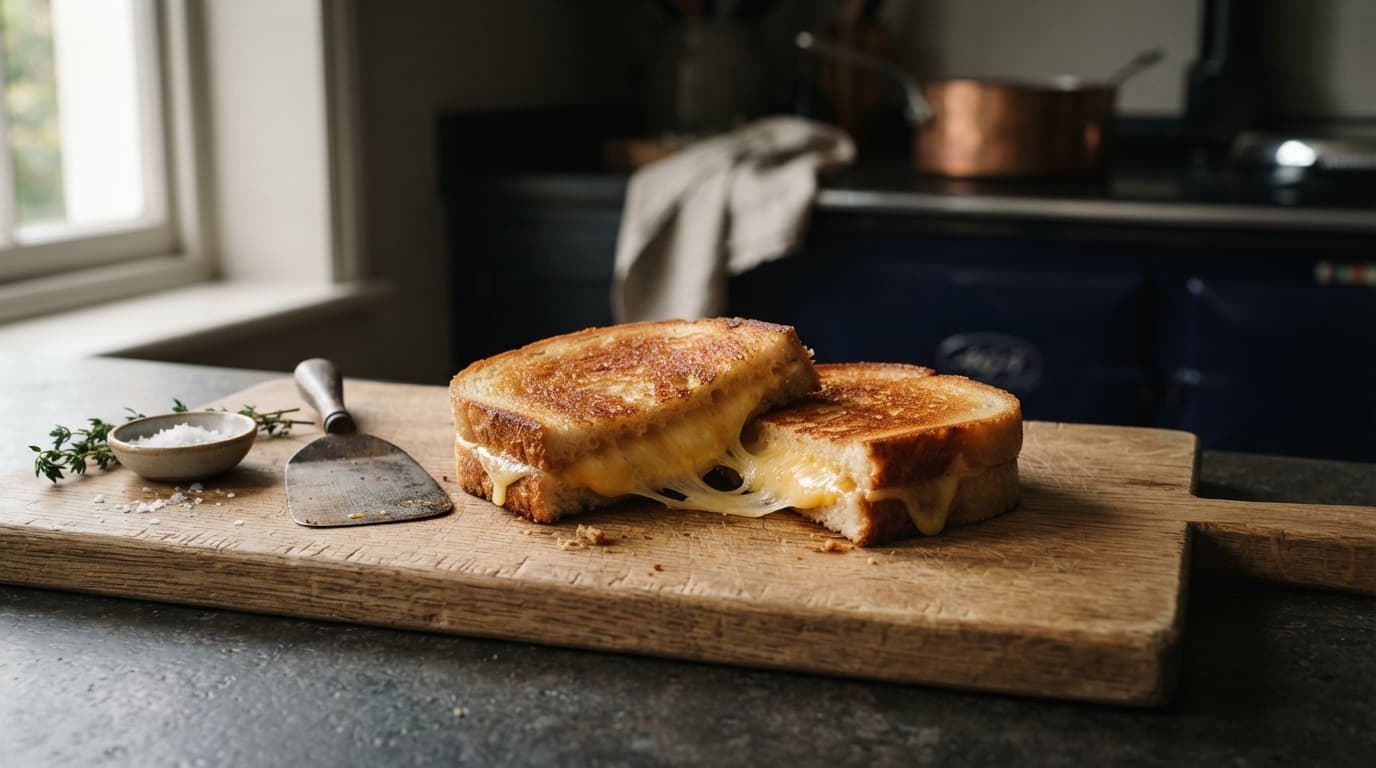
No single person invented grilled cheese. Melted cheese on bread has informal roots stretching back centuries, and the specific sandwich Americans know today took shape gradually during the 1920s and 1930s, once sliced bread and cheap, reliably melting processed cheese both became widely available at the same time. It's a food that came together from several separate developments rather than one identifiable moment or inventor.
That answer tends to disappoint people looking for a tidy origin story, but it's also the more interesting version. Grilled cheese is really a case study in how a genuinely simple food idea, bread plus melted cheese plus heat, gets reinvented independently across cultures and centuries until circumstances finally line up to turn it into a defined, named dish.
Melted cheese on bread predates any single country's claim
Combining bread and melted cheese isn't a 20th-century idea. Ancient Romans are commonly cited as early practitioners of a bread-and-cheese combination cooked over heat, and versions of the same basic concept, bread, cheese, some kind of heat source, show up informally across many food cultures over the centuries that followed. None of these historical examples map cleanly onto the modern American grilled cheese sandwich, closed, two slices, cooked in a skillet, but they establish that the underlying idea is old and widespread rather than a single culture's invention.
This matters because it rules out the kind of clean, single-country founding story some other foods claim. Nobody in ancient Rome or medieval Europe was making anything resembling a modern sandwich, since sliced bread and pre-formed cheese products didn't exist yet in the forms we'd recognize. What existed was the general concept, and that concept had centuries to circulate and mutate before anything like the sandwich we eat today came together.
Medieval European cooking offers a similar loose precedent, with toasted bread topped with cheese showing up in various regional forms long before "sandwich" was a word in English. The modern sandwich concept itself, two pieces of bread with a filling between them, is generally traced to 18th-century England, well after these looser bread-and-cheese combinations were already common. Grilled cheese, in other words, inherited its basic idea from a much older, more diffuse food tradition rather than being built from scratch as a sandwich from day one.
The Great Depression brought the pieces together
The specific American grilled cheese sandwich is most closely tied to the Great Depression era of the 1920s and 1930s, when two separate developments converged to make it an easy, cheap meal for struggling households. Sliced bread became widely commercially available during this period, removing the need to slice a loaf by hand for every sandwich. At the same time, inexpensive, shelf-stable American cheese was newly widespread, thanks largely to a patent filed more than a decade earlier.
Depression-era cooking leaned hard on meals that stretched a small grocery budget as far as possible, and a sandwich built from cheap bread and cheap cheese, warmed until the cheese melted, fit that need about as well as any dish could. It was filling, it used ingredients most households could actually afford, and it required no specialized equipment beyond a stovetop. That combination of circumstances, not one inventor's idea, is what turned melted cheese on bread from a loose historical concept into a specific, common American dish during this exact window.
Home economics classes and government-distributed recipe pamphlets from the era reinforced the sandwich's spread further, since a cheap, filling, protein-and-carbohydrate meal was exactly what budget-conscious cooking guidance of the period wanted to promote. Grilled cheese didn't need a marketing campaign to spread nationally; it needed to be cheap, simple enough for an inexperienced cook to make reliably, and built from ingredients a struggling household could keep on hand, the same practical, no-frills instinct behind a budget kitchen thermometer that does its job without the extras.
James Kraft's patent made the cheese part possible
One piece of this story is genuinely well documented and worth naming specifically: James L. Kraft patented pasteurized processed cheese in 1916. That's a confirmed historical fact, not folklore, and it matters here because processed cheese solved a real practical problem that natural cheese didn't handle nearly as well at the time. Kraft's processed cheese was shelf-stable, consistent from batch to batch, and melted evenly and predictably when heated, exactly the qualities you want from the cheese in a sandwich you're pressing in a hot pan.
It's worth being precise about what Kraft's patent actually covers, since it's easy to overstate. He patented a cheese product, a specific manufacturing process for pasteurized processed cheese, not the grilled cheese sandwich itself. Kraft didn't invent the dish; he invented a key ingredient that made the dish far easier and cheaper to make well, at a moment when Depression-era households were specifically looking for cheap, reliable ingredients. Without that widely available, evenly melting cheese already on the market, the sandwich's rise during the 1920s and '30s would have looked very different, or come together on a slower timeline.
Processed cheese solved a problem natural cheese genuinely had at the time: consistency and shelf life. Natural cheese varies from wheel to wheel and can behave unpredictably under heat, sometimes separating into an oily, stringy mess rather than melting smoothly. Kraft's pasteurized processed cheese was engineered specifically to melt evenly and hold up to storage and shipping far better than most natural cheeses of the era, which mattered enormously in a period before most households had reliable refrigeration. A cheese that stayed good longer and melted predictably every time was a genuine improvement for a home cook working with a tight budget and no margin for a ruined dinner.
Cheese dreams: the open-faced sandwich that came first
Before the closed, grilled sandwich most people picture today, there was the cheese dream, an open-faced sandwich of melted cheese on a single slice of bread, popular in the early 20th century. It's a well-documented precursor rather than a folklore claim: cheese dreams appeared on menus and in home cooking well before the fully closed, pan-grilled version became standard.
The shift from an open-faced cheese dream to a closed, two-slice sandwich pressed in a hot pan on both sides represents the last real structural change in the dish's evolution. Closing the sandwich and grilling both sides gave it the crisp, browned exterior and fully melted interior that define grilled cheese today, a meaningful improvement over an open-faced version where the bread underneath the cheese never got the same texture. This evolution happened gradually rather than at one identifiable moment, mirroring the rest of the dish's history: no single cook or restaurant is credited with flipping the switch from open-faced to closed.
World War Two-era rationing likely reinforced the sandwich's staying power a decade after its Depression-era rise, for many of the same underlying reasons. Butter and cheese were both rationed commodities at points during the war, but a grilled cheese sandwich still stretched a small amount of each further than plenty of other dishes could, keeping it in regular rotation in American kitchens well past the specific economic crisis that first popularized it. A dish that proves useful across two very different periods of scarcity, the Depression and wartime rationing, tends to stick around afterward simply because an entire generation grew up relying on it.
Why "grilled cheese" became the name (with a caveat)
The specific term "grilled cheese," as opposed to "cheese dream" or another older label, is often traced to the 1960s, sometimes connected to advertising from brands like Betty Crocker. That's worth including because it's a genuinely common piece of food trivia you'll run into elsewhere, but it deserves a clear caveat: this specific naming claim isn't independently confirmed through a primary historical source the way Kraft's 1916 patent is. Treat it as commonly repeated food folklore rather than settled history.
What is reasonably clear is that the dish existed, in something close to its modern form, well before the term "grilled cheese" became the dominant name for it. Naming conventions for foods often lag behind the food's actual popularization by years or decades, since a dish can spread through home kitchens and regional restaurants under several different informal names before one label wins out nationally, often helped along by advertising, cookbooks, or media coverage that popularizes one specific term over its competitors.
Regional and diner menus through the mid-20th century used a real mix of names before "grilled cheese" settled in as the standard: "toasted cheese sandwich," "cheese melt," and simple variations on "cheese dream" itself all appeared on menus well into the postwar decades. This kind of naming overlap is common for foods that spread organically through home cooking and small regional restaurants rather than being introduced all at once by a single company or chef with a fixed name already attached.
Why grilled cheese resists a tidy origin story
Grilled cheese is a genuinely useful example of how food history actually works most of the time, which is messier and less satisfying than a single-inventor narrative but arguably more honest. A few separate threads, an ancient, informally documented practice of combining bread and melted cheese, a specific industrial cheese innovation in 1916, a Depression-era economic squeeze that rewarded cheap and filling meals, and a naming convention that solidified even later, all had to converge before the dish as we know it existed and had its current name.
This pattern isn't unique to grilled cheese. A lot of foods with seemingly obvious, simple origins turn out to have similarly tangled histories once you actually look past the popular version of the story. Delmonico steak is a good parallel from the savory side of the menu: a name with a real, documented 19th-century origin that nonetheless never settled into one fixed, standardized meaning, for reasons that trace back to timing and regional drift rather than any single mistake. Grilled cheese just happens to be a particularly clean example on the sandwich side, since each piece of its history, the ancient precedent, the Kraft patent, the Depression-era popularization, the later naming, is independently well documented enough to trace, even though no single thread on its own explains the whole dish.
Recognizing this kind of layered history is useful the next time you run into a food with a suspiciously tidy invention story attached to it. A dish that seems simple enough to have one obvious inventor moment often has a background at least as complicated as grilled cheese's, and the more interesting, more accurate answer is usually the one that resists a single clean narrative rather than the one that provides it.
What this means next time you make one
Grilled cheese earned its permanent spot in American home cooking specifically because it required no special skill, no expensive ingredients, and no advance planning, just bread, cheese, and a hot pan, the same qualities that made it a smart choice during a genuine economic hardship a century ago. That basic appeal hasn't changed, which is part of why it's stuck around this long without needing a marketing push or a rebrand.
If you're making one tonight, you're recreating a combination of ingredients and technique that took roughly a century, an ancient bread-and-cheese tradition, an early-20th-century open-faced version, a 1916 cheese patent, and a Depression-era economic need, to fully come together into the sandwich sitting in your pan. That's a fair bit of unglamorous history packed into something that takes about five minutes to cook, which is probably the best argument yet for not assuming a food's simplicity means its history is simple too. If you're pairing your sandwich with something warm on the side, a properly held simmer is exactly the technique behind a good tomato soup to go with it, another dish with a much longer and messier backstory than its short ingredient list suggests.
If cheese and bread genuinely interest you as a combination, it's worth noticing how many cuisines beyond the American diner tradition build entire dishes around the same basic pairing, from melted cheese folded into flatbread to baked dishes anchoring a shared table. A kitchen built around wood-fire cooking and mezze-style shared plates is drawing on that same universal instinct, bread and something rich melted or charred alongside it, even when the specific dish looks nothing like a diner-style sandwich.
Frequently asked questions
Who actually invented the grilled cheese sandwich?+−
No single person is credited with inventing it. Melted cheese on bread has informal roots going back centuries, and the specific American grilled cheese sandwich took shape gradually during the Great Depression rather than being invented by one identifiable person.
When did grilled cheese become popular in America?+−
During the 1920s and 1930s. Sliced bread became widely available and inexpensive processed cheese, following James Kraft's 1916 patent, made melted-cheese sandwiches an affordable, filling meal during the Great Depression.
What is a cheese dream?+−
An open-faced sandwich of melted cheese on a single slice of bread, popular in the early 20th century before the closed, grilled, two-slice version became the standard. It's a well-documented precursor to the modern grilled cheese sandwich.
Did Kraft invent grilled cheese?+−
No. James Kraft patented pasteurized processed cheese in 1916, which is well documented, but that's a cheese product, not the sandwich itself. His invention made a cheap, evenly melting cheese widely available, which helped the sandwich become common, but Kraft didn't invent grilled cheese as a dish.
Why is the sandwich called "grilled cheese" specifically?+−
That's less certain than the sandwich's history itself. The term is often traced to the 1960s, sometimes linked to advertising from brands like Betty Crocker, but that specific claim is commonly repeated food trivia rather than something confirmed through a primary historical source.
Roughly 185 to 205°F, well below a full boil at 212°F. Here's how to spot it by bubble pattern alone, since most stovetop cooking never touches a thermometer.
9 min read
An air fryer at 350-400°F for 3-5 minutes gets fries crisp again. The oven at 375-400°F works nearly as well spread thin, while a microwave leaves them soggy every time.
9 min read
The oven gives the most even result: 350°F for 15-20 minutes in foil. Microwave is faster with a damp paper towel; air fryer needs a foil-then-unwrap approach.
9 min readTables release two weeks out on Resy, Shukette's own booking platform.
Book Now →