How Many Calories Are in a Slice of Pizza?
Editorial desk · 9 min read · Updated 2026-08-23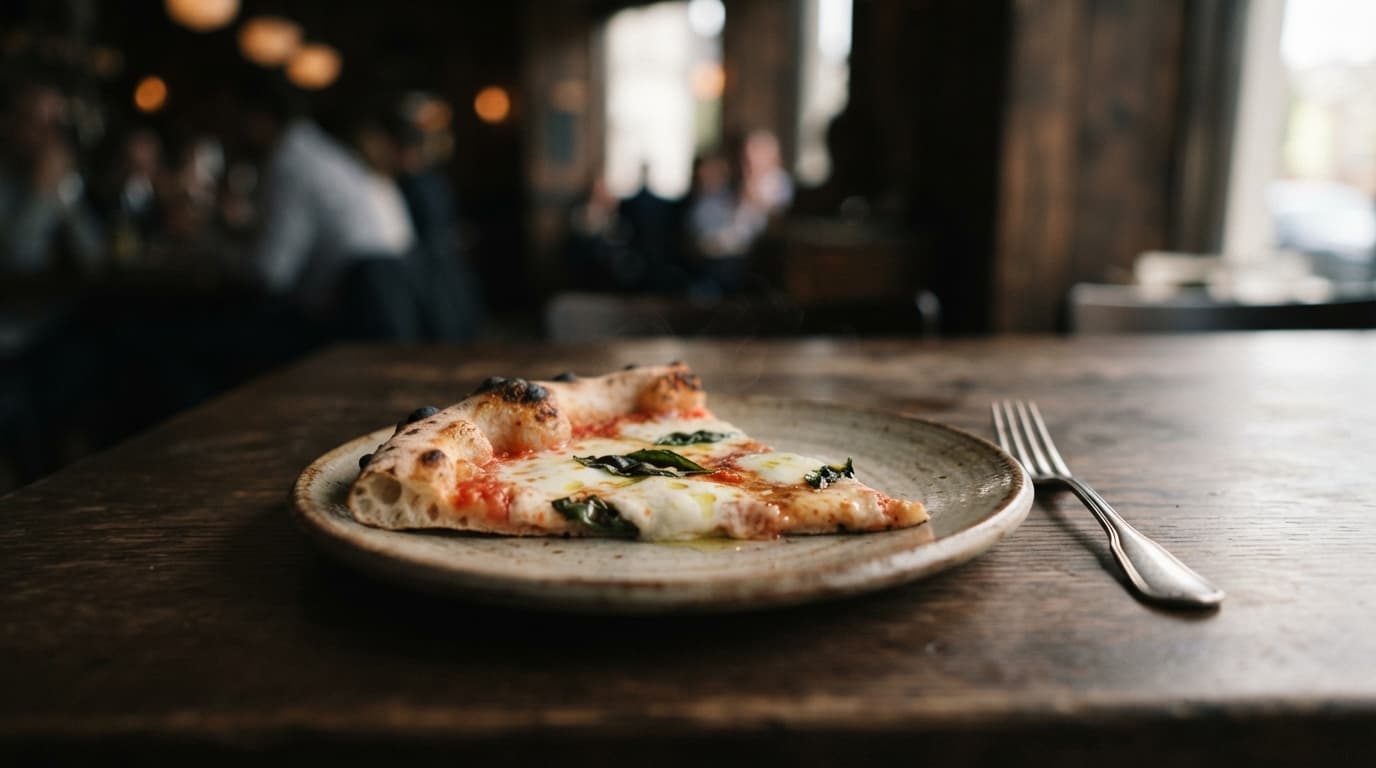
A standard cheese pizza slice runs roughly 250 to 300 calories, based on USDA reference data for a 14-inch cheese pizza cut into eight slices. That number is a reasonable starting estimate, not a fixed fact, because "a slice" isn't actually a standardized serving size. Pie diameter and how many pieces a given pie gets cut into both change how big an individual slice really is, which means two pizzas can both hand you "one slice" while putting very different amounts of food on your plate.
That gap is worth understanding before you treat any single calorie number as gospel, since the honest picture here has more range in it than most quick answers let on.
The reference number, and where it comes from
The commonly cited figure, roughly 285 calories for one-eighth of a 14-inch cheese pizza, comes from USDA FoodData Central, the federal government's public nutrition database. It's a real, government-sourced reference point, which is why it's worth starting from, but it describes one specific pizza size cut into one specific number of pieces. Treat it as a middle-of-the-road estimate for a standard cheese slice, roughly 250 to 300 calories, rather than a number that applies precisely to whatever slice happens to be in front of you.
That range already accounts for the fact that actual slice size varies even among pizzas that look similar. Crust thickness, exact cheese quantity, and sauce amount all shift the number somewhat even between two plain cheese pizzas of the same overall diameter, which is part of why USDA's own reference figure is presented as an approximate value rather than a single precise one.
It's worth understanding roughly where those calories come from, too, since it helps explain why the number shifts as much as it does. The crust itself, mostly refined flour, contributes a meaningful share of a slice's total calories through its carbohydrate content, and a thicker crust simply means more of that base calorie contribution before cheese or toppings enter the picture at all. Cheese contributes both protein and a substantial amount of fat, which is calorie-dense per gram compared to the crust's carbohydrates, so the amount of cheese on a given slice moves the number more per added ounce than the crust does. Sauce contributes comparatively little on its own, a thin layer of tomato sauce is low in calories relative to the other two components, which is part of why a saucier slice doesn't necessarily run much higher than a lightly sauced one, while a cheesier slice reliably does.
Why "one slice" is such a loose unit of measurement
The core problem with asking "how many calories are in a slice of pizza" is that a slice isn't a fixed amount of food the way a cup or an ounce is. Two things independently determine how big any given slice actually is, and both vary enormously across pizzerias.
Pie size is the first variable. Pizzas commonly range from about 10 inches across on the small end to 18 inches or more for a large pie. A 10-inch personal pizza and an 18-inch party-sized pie contain a very different total amount of dough, sauce, and cheese, even before anyone starts cutting slices.
Slice count is the second, and it's just as important. The same pie might be cut into 6, 8, 10, or 12 pieces depending on the pizzeria's convention, and cutting a pie into more pieces obviously makes each individual slice smaller, with fewer calories, even though the whole pie's total calorie count hasn't changed at all.
Put those two variables together and you can end up with two servings that are both honestly labeled "one slice" but differ in actual food weight, and therefore calories, by two times or more. A small pie cut into six generous wedges gives you a noticeably bigger slice than a large pie cut into twelve thin ones, even though intuition might suggest the opposite given the size difference between the two pies themselves. This is exactly the kind of measurement ambiguity that makes "a slice" a useful rough shorthand in conversation but a genuinely unreliable unit for anyone trying to track calories with any precision.
A quick way to see how much this compounds: a 12-inch pie has roughly 113 square inches of surface area, while an 18-inch pie has roughly 254 square inches, more than double, even though the diameter only grew by half. Cut the smaller pie into six slices and the larger one into twelve, and each slice of the bigger pie is actually close in size to each slice of the smaller one, despite the finished pies looking dramatically different in scale sitting side by side on a counter. Area scales with the square of the radius, not in a straight line with diameter, which is exactly why eyeballing pie size as a rough guide to slice size is so easy to get wrong without actually doing the math.
How style and toppings shift the number further
Beyond pie size and slice count, the pizza's actual style and topping load push the calorie range even wider. A thin-crust cheese slice generally sits toward the lower end of the range, often closer to 150-200 calories for a smaller, lighter slice, since there's simply less dough and often less cheese per slice than a thicker-crust style carries.
Deep-dish and stuffed-crust styles sit at the opposite end. More dough, more cheese, and often more sauce packed into a single slice pushes deep-dish well past a standard cheese slice's calorie count, sometimes considerably past 400 calories for a single generous piece, depending on exactly how it's built.
Toppings matter just as much as crust style, often more. A plain cheese slice is close to the lightest option on a typical menu. Adding a single vegetable topping, mushrooms or peppers, for instance, adds relatively little. Meat toppings add considerably more: pepperoni, sausage, and bacon all add both calories and fat, and a slice loaded with several meat toppings plus extra cheese can reasonably land anywhere from 350 to 480 calories or more, depending on quantity.
Here's a rough sense of how these factors stack, without pinning down any one restaurant's exact recipe:
| Style/topping | Approx. calorie range per slice |
|---|---|
| Thin crust, plain cheese | ~150-220 |
| Standard hand-tossed, plain cheese | ~250-300 |
| Standard crust, single meat topping | ~300-350 |
| Standard crust, multiple meat toppings + extra cheese | ~350-450+ |
| Deep-dish or stuffed crust | ~400-480+ |
Treat these as rough zones rather than fixed numbers, since actual recipes and portion sizes vary by pizzeria even within the same general style.
The flour and dough style behind a given crust plays a real, if secondary, role in this range too. A bread-flour or high-gluten New York-style dough tends to be rolled thinner and wider per slice than a puffier, air-filled Neapolitan-style 00-flour crust, which means the two styles can end up with fairly similar per-slice calorie counts despite using different flour and producing very different textures, since one trades width for airiness and the other trades airiness for width. Deep-dish dough, by contrast, is both thick and dense, which is why it consistently lands at the high end of the range regardless of which specific flour a given recipe calls for.
Practical ways to estimate a slice you're actually eating
Since no single number covers every pizza, a more useful approach is comparing what's in front of you to a known reference point rather than reaching for one fixed figure. Start from the roughly 250-to-300-calorie standard cheese slice as your baseline, then adjust up or down based on what's actually different about your specific slice.
If the pie looks notably larger than a typical 14-inch pizza, or if it's been cut into fewer, bigger pieces than the standard eight, adjust the estimate upward, since you're simply getting more food per slice than the reference figure assumes. If it's been cut into more, smaller pieces than usual, or if the crust is visibly thinner than a standard hand-tossed crust, adjust downward instead.
Topping load is the other major adjustment. Plain cheese stays close to the baseline. Every additional topping, and especially every meat topping, nudges the estimate upward, with a heavily loaded slice reasonably landing 100 to 150 calories or more above a plain cheese slice of the same size. Extra cheese specifically, a common upcharge at a lot of pizzerias, adds a meaningful amount on its own even without any additional toppings layered on top of it.
None of this produces a precise number, but it gets you into a reasonable, honest range faster than assuming every slice matches one fixed figure regardless of size, style, or toppings. The same practical instinct applies to plenty of other foods where "one serving" hides more variation than the label suggests, the same reason it's worth confirming a specific cut's actual temperature rather than trusting a generic number when precision actually matters for what you're eating.
When a generic estimate isn't precise enough
A rough estimate is genuinely fine for casual, everyday eating, but there are moments when more precision matters, tracking calories for a specific health or fitness goal, managing a medical condition where portion accuracy matters, or simply wanting an honest number rather than a guess. In those cases, a specific restaurant or chain's own published nutrition information, where it's publicly available, is a far better source than any general estimate this article or any other could give you.
Published nutrition data reflects that exact product: the specific recipe, the specific portion size, the specific slice count a given restaurant actually uses, rather than an average drawn across the entire category of "pizza." A generic estimate has to account for the huge range across pie sizes, crust styles, and topping combinations described above; a specific restaurant's own listed number for its own specific slice doesn't carry that same uncertainty, since it's describing one known, fixed product rather than an entire category.
This is also where asking directly, rather than guessing, genuinely pays off if a restaurant doesn't publish detailed nutrition figures on its own site. A server can usually tell you roughly how a pie is cut and how heavily a given style is topped, and that kind of direct information narrows an estimate considerably compared to going in blind. The same instinct applies to any dish with real variability behind a simple-sounding name, asking about a specific menu item's makeup rather than assuming a generic version of the dish applies to the exact plate in front of you, the same reasoning behind ordering with a group around a shared spread rather than assuming every plate on the table carries the same rough calorie count.
This is a genuinely useful distinction to carry forward beyond pizza specifically. Any food sold in wildly variable portion sizes, a bagel, a burger, a slice of cake, or a diner sandwich built the same loose way pizza is, benefits from the same approach: use a general range for casual estimating, but reach for a specific, published number whenever the specific product and its actual nutrition information are available and precision actually matters to you.
A reasonable range beats a fake precise number
A standard cheese pizza slice lands in the neighborhood of 250 to 300 calories, a genuinely useful starting point backed by USDA reference data, but it's a starting point rather than a fixed answer. Pie size, slice count, crust style, and toppings all push the real number for any specific slice meaningfully higher or lower than that baseline, sometimes by a factor of two or more between one pizzeria's slice and another's.
Next time you're estimating a slice's calories, resist the pull toward one clean number and instead ask the two questions that actually matter: how big is this specific pie, and how heavily is this specific slice topped? Answering those honestly gets you a far more useful estimate than repeating a single figure that was only ever describing one particular pizza, cut one particular way, in the first place.
Frequently asked questions
How many calories are in an average slice of cheese pizza?+−
Roughly 250 to 300 calories, per USDA reference data based on a standard 14-inch cheese pizza cut into eight slices. Actual slices vary quite a bit above and below that depending on the pizzeria.
Why is a pizza slice such an imprecise way to measure calories?+−
Because a pizza slice isn't a fixed serving size. Pies commonly run 10 to 18 inches across, and a given pie might be cut into 6, 8, 10, or 12 slices, so two servings both called one slice can differ in actual food weight by two times or more.
Do toppings significantly change a pizza slice's calorie count?+−
Yes, substantially. A plain cheese slice sits toward the lower end of the range, while a slice loaded with multiple meat toppings and extra cheese can run well past 400 calories, depending on how much topping is actually piled on.
Is thin crust always lower in calories than thick or deep-dish?+−
Generally yes, since less dough usually means less overall food weight per slice, but it's not an absolute rule. A thin-crust slice loaded with heavy toppings can still land higher than a plain thick-crust slice with light toppings.
Where can I find an exact calorie count for a specific pizza?+−
A specific restaurant or chain's own published nutrition information, when it's publicly listed, is far more precise than any general estimate, since it reflects that exact product's actual recipe, portion size, and slice count rather than an average across the category.
No single person did. Melted cheese on bread is centuries old, but the sandwich took shape in the 1920s and '30s once sliced bread and cheap cheese arrived.
9 min read
Roughly 185 to 205°F, well below a full boil at 212°F. Here's how to spot it by bubble pattern alone, since most stovetop cooking never touches a thermometer.
9 min read
An air fryer at 350-400°F for 3-5 minutes gets fries crisp again. The oven at 375-400°F works nearly as well spread thin, while a microwave leaves them soggy every time.
9 min readTables release two weeks out on Resy, Shukette's own booking platform.
Book Now →