How Long to Cook a 20-Pound Turkey
Editorial desk · 9 min read · Updated 2026-08-22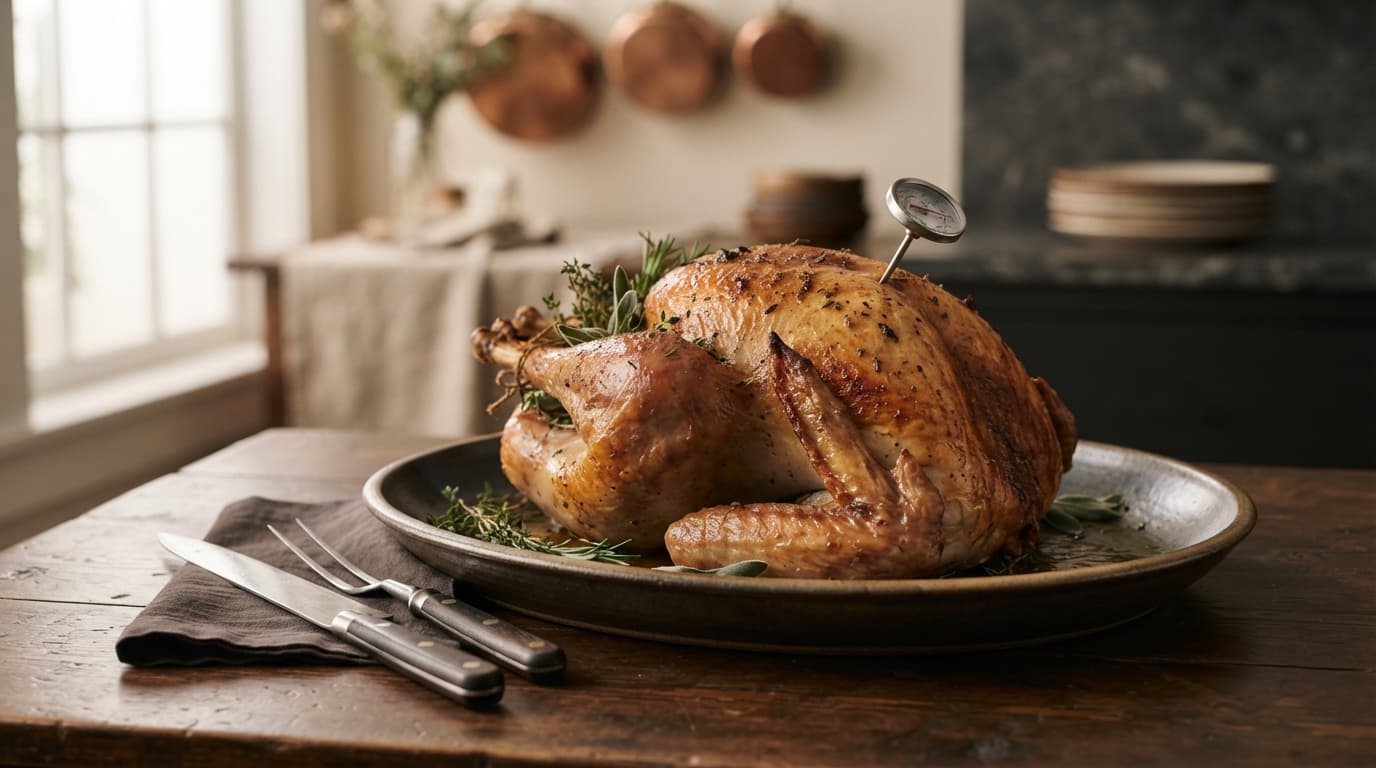
FoodSafety.gov's official roasting chart lists 4¼ to 4½ hours for a 20-to-24-pound unstuffed turkey, and that figure is based on a 325°F oven, not 350°F. Add roughly 30 to 45 minutes if the turkey is stuffed. That distinction matters because the officially documented chart doesn't actually cover 350°F as a reference temperature, so anyone cooking at 350°F is working from a slightly different starting point than the government's own published guidance.
Regardless of oven temperature, the estimate is a planning tool, not a guarantee. The only way to know a 20-pound turkey is actually done is checking with a food thermometer in three specific places, not trusting a clock alone, however carefully the estimate was calculated.
The official chart, and why it's built around 325°F
FSIS's consumer guidance for roasting turkey consistently sets 325°F as the reference oven temperature, and the roasting chart's times are built around that number specifically. For a 20-to-24-pound turkey, that's 4¼ to 4½ hours unstuffed, 4¾ to 5¼ hours stuffed. Smaller birds finish faster: an 8-to-12-pound turkey runs 2¾ to 3 hours unstuffed at the same 325°F, for comparison.
Cooking at 350°F instead of 325°F will generally finish faster than the chart's estimate, since a higher oven temperature delivers more heat over the same span of time. But because the official chart doesn't include a 350°F column, there's no equally authoritative number to point to for that specific combination. This is worth being upfront about rather than presenting an invented precise time as if it carried the same weight as the actual published figure.
Why weight matters more than a single fixed number
A 20-pound turkey sits in the middle of a fairly wide range on the official chart, and even small weight differences shift the estimate meaningfully. The chart treats 20 to 24 pounds as one bracket, which means a 20-pound bird likely finishes closer to the 4¼-hour end of that range, while a 24-pound bird sits closer to 4½ hours or slightly beyond. If your turkey's actual weight sits near either edge of a bracket rather than its center, lean your expectations toward the appropriate end of the stated range rather than assuming the midpoint applies evenly across the whole bracket.
This is also why a kitchen scale or the weight printed on the turkey's packaging matters more than eyeballing size. Two turkeys that look roughly similar can differ by several pounds, and that difference is enough to meaningfully shift which end of the chart's range actually applies.
Whether the turkey is fresh or previously frozen and fully thawed doesn't change the roasting chart's estimate, since the chart assumes a fully thawed bird either way. A turkey that's only partially thawed cooks unevenly and unpredictably compared to one that's completely thawed through, which is part of why FSIS guidance is specific about thawing a turkey fully, generally allowing roughly 24 hours of refrigerator thawing time per 4 to 5 pounds, before it ever goes in the oven.
Checking temperature in three places, not one
A whole turkey doesn't cook evenly throughout, which is why FSIS guidance calls for checking in three specific spots rather than a single reading anywhere convenient: the innermost part of the thigh, the innermost part of the wing, and the thickest part of the breast, avoiding bone in each location. The thigh is generally checked first, since dark meat near the joint tends to be the last part of the bird to reach a safe temperature, with the wing and breast confirmed afterward.
All three spots need to reach 165°F before the turkey as a whole is considered done. A breast reading of 165°F with a thigh still below that mark doesn't mean the turkey is finished; it means the thinner, faster-cooking breast has caught up while the denser thigh hasn't yet. This three-point check is a meaningfully more thorough process than checking once and calling it done, and it exists specifically because a bird this large cooks unevenly enough that a single spot check can miss real gaps elsewhere in the same turkey.
Whether the turkey is trussed also affects how evenly it cooks. A tightly trussed bird, with legs and wings pulled close against the body, cooks somewhat less evenly than one left untrussed or loosely tied, since trussing shields parts of the thigh and wing from direct oven heat that would otherwise reach them more quickly. Many current guidelines lean toward leaving a turkey untrussed, or only loosely tied, specifically because it promotes more even cooking across all three checkpoints rather than leaving the thigh consistently lagging behind the rest of the bird.
Placement in the oven matters too, for the same reasons it does with any large roast. A turkey positioned too close to the oven's back wall or heating element cooks unevenly compared to one centered on a middle rack with clearance on all sides. If your oven runs noticeably hotter in one area, rotating the roasting pan partway through the long cook helps offset that unevenness better than leaving the bird in one fixed position for the entire multi-hour cook.
The roasting pan itself plays a role too. A shallow, open roasting pan lets hot air circulate around the bird more freely than a deep, high-walled pan, which can trap the turkey lower down and shield it from some of the oven's ambient heat. A V-shaped or elevated roasting rack inside the pan helps further, keeping the bird off the bottom of the pan so heat reaches the underside as well as the top and sides, rather than leaving the lower portion sitting in its own rendered fat and juices for the entire cook.
Stuffing changes the safety calculation, not just the time
If the turkey is stuffed, the center of the stuffing itself becomes a fourth thing that has to reach 165°F, not an optional extra step. FSIS is explicit that stuffing should never be removed from a turkey before the stuffing itself reaches that same safety threshold, since undercooked stuffing removed early can contaminate meat that's already fully cooked. The turkey and the stuffing inside it are not two independently timed items; the whole assembly is done only once every part of it, including the stuffing's center, has actually reached a safe temperature.
This is part of why stuffed turkeys take longer than unstuffed ones of the same weight: the stuffing itself needs to come up to temperature, and it insulates the surrounding cavity in a way that slows how quickly heat reaches the thigh meat closest to it. If you're working with a tight timeline, cooking stuffing separately in its own dish rather than inside the bird removes this added time and complexity entirely, without changing anything about how the turkey itself needs to be checked.
This same principle, that a filled or stuffed item needs its filling checked independently rather than assumed to match the surrounding meat, applies to any stuffed poultry dish, not just a whole holiday turkey. Whenever a recipe combines a protein with a filling of any kind, the filling's own temperature, not just the surrounding meat's, is what actually determines whether the whole dish is safe to serve.
What actually changes at a higher oven temperature
Raising the oven temperature above the chart's 325°F baseline generally shortens cooking time, but it also increases the risk of the exterior browning, or even drying out, before the interior has fully caught up, particularly on a bird as large as 20 pounds where there's a lot of mass for heat to penetrate. This tradeoff is part of why 325°F is the standard reference point in official guidance rather than a higher, faster-cooking temperature: it balances a reasonable total cooking time against giving the interior enough time to reach a safe temperature without overcooking the outside first.
If you do cook at 350°F, start checking meaningfully earlier than the 325°F chart's low end would suggest, since the higher temperature is doing more work per unit of time. Treat the official chart's numbers as your outer boundary for when the turkey should be at most done, and check well before that point rather than assuming a higher temperature simply shifts the whole timeline down by a fixed, predictable amount.
A loose covering of foil over the breast for part of the cook is a common way to manage this tradeoff at any oven temperature, not just 350°F. Since the breast typically finishes before the thigh does, tenting the breast area with foil partway through, once it's reached a good color, protects it from further browning or drying out while the rest of the bird, particularly the slower-cooking thigh, catches up to a safe temperature. This is a texture and appearance choice rather than a safety requirement, but it's a genuinely useful tool for managing the uneven cooking that comes with a large, whole bird regardless of exact oven temperature.
Two variables rarely mentioned in a standard roasting chart can shift a 20-pound turkey's actual cooking time beyond what either the 325°F or 350°F estimate predicts. At higher elevations, water boils at a lower temperature and general convection inside an oven behaves somewhat differently, which can extend roasting times measurably compared to sea level; cooks at elevation often need to add extra time and check earlier rather than trusting a chart built around lower-altitude conditions. Oven calibration is the more common issue at any elevation: a home oven's dial can run 15 to 25 degrees off its actual internal temperature without any obvious sign, which means a turkey cooking in an oven that reads 325°F but actually runs cooler finishes later than the chart predicts, sometimes by a meaningful margin over a four-hour cook. An inexpensive oven thermometer placed on the rack next to the turkey, rather than relying on the oven's built-in display, is the simplest way to catch this kind of drift before it affects a holiday meal, and it matters more for a cook this long than it would for a quick 20-minute bake, since even a modest, consistent temperature gap compounds across four-plus hours in a way it wouldn't across a shorter cook.
Resting time still matters after a long cook
Once a 20-pound turkey reaches a safe temperature in all three checked spots, resting it before carving, generally 20 to 30 minutes for a bird this size, lets juices redistribute through the meat rather than running out onto the cutting board the moment you start slicing. This is a texture consideration rather than an additional safety step; the turkey is already safe to eat once it reaches 165°F throughout, and resting afterward doesn't change that status, it just improves how the meat eats once carved.
For a smaller cut like a chicken breast or a portioned turkey breast, the same resting principle applies on a shorter timescale, a few minutes rather than half an hour, simply because there's less total mass holding heat and moisture. The logic scales with size: bigger cut, longer rest, same underlying reason for doing it.
If you're feeding a large group with a bird this size, planning the rest of the meal's timing around the turkey's long cook rather than the other way around tends to produce a smoother overall dinner, since a 20-pound turkey's multi-hour commitment is the least flexible part of the whole meal to shift once it's already in the oven.
Planning around a bird this size
Plan around 4¼ to 4½ hours at 325°F for an unstuffed 20-to-24-pound turkey, add time for stuffing, and treat 350°F as running faster than that estimate without a precise official number to replace it. Whatever temperature you use, the actual finish line is the same regardless: 165°F confirmed in the thigh, wing, and breast, and in the stuffing's center if the bird is stuffed. A large bird rewards patience and a working thermometer far more than it rewards guessing at an exact number of minutes. If managing a turkey this large feels like more than you want to take on for a specific meal, a kitchen built around smaller, faster-cooking cuts sidesteps the whole multi-hour timeline, trading the scale of a holiday bird for a meal that's ready in a fraction of the time.
Frequently asked questions
How long does it take to cook a 20-pound turkey?+−
FoodSafety.gov's official roasting chart lists 4 1/4 to 4 1/2 hours unstuffed for a 20-to-24-pound turkey, based on a 325°F oven. Stuffed turkeys in that weight range need about 30 to 45 minutes longer, 4 3/4 to 5 1/4 hours total.
Does the chart's time change if I use 350°F instead of 325°F?+−
The official USDA chart is built around 325°F specifically, not 350°F. Cooking at a higher temperature will finish somewhat faster, but there's no official chart for that exact combination, so checking with a thermometer well before the 325°F estimate's low end is the safer approach.
Where do I check the temperature on a whole turkey?+−
Three places: the innermost part of the thigh, the innermost part of the wing, and the thickest part of the breast, avoiding the bone in each spot. All three need to reach 165°F, with the thigh typically checked first since it usually finishes last.
Is it safe to take stuffing out of the turkey before the bird reaches 165°F?+−
No. If the turkey is stuffed, the center of the stuffing itself must also reach 165°F before either the stuffing or the turkey is safe to eat. Removing stuffing early risks contaminating the already-cooked meat with undercooked stuffing.
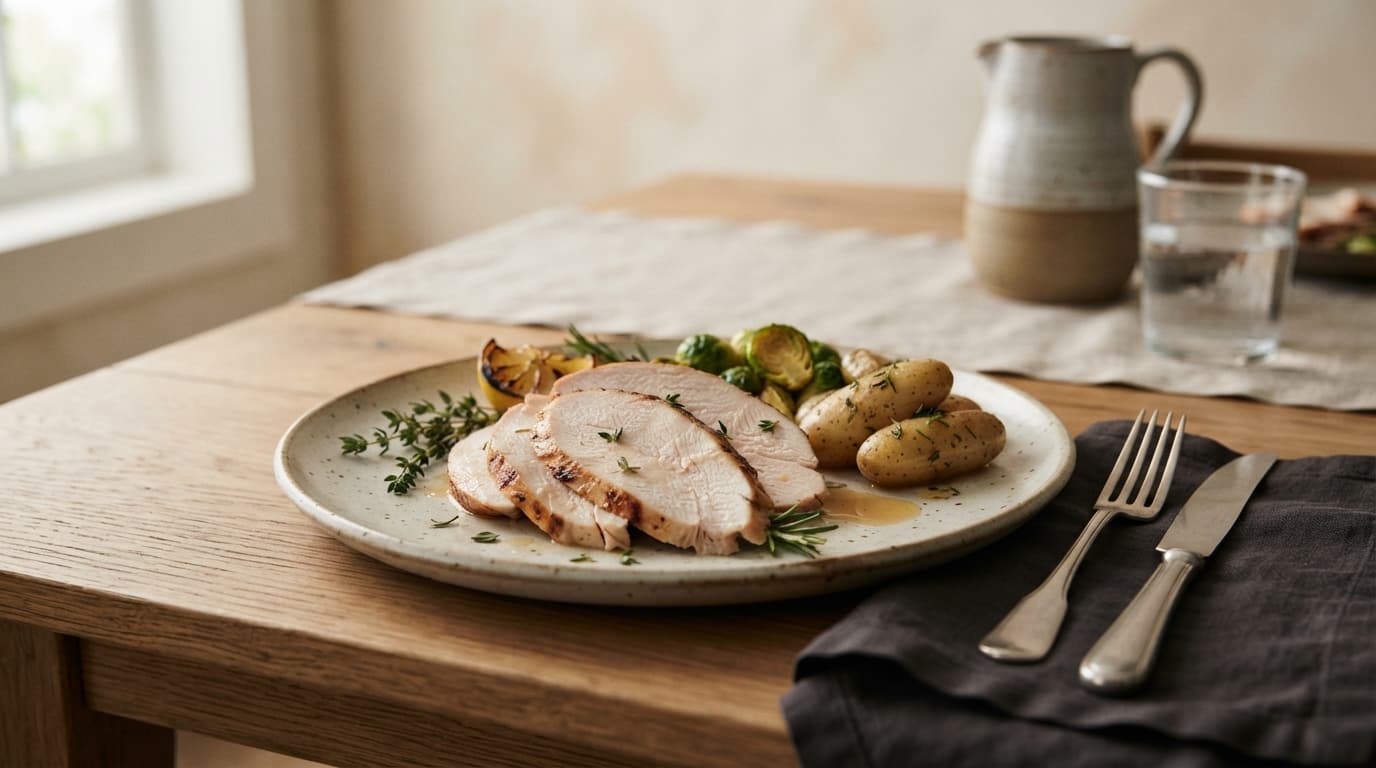
Plan on 3/4 to 1 pound of boneless turkey breast per person, less than the USDA's 1 to 1 1/4 pounds for whole turkey, since boneless meat has no bone weight.
10 min read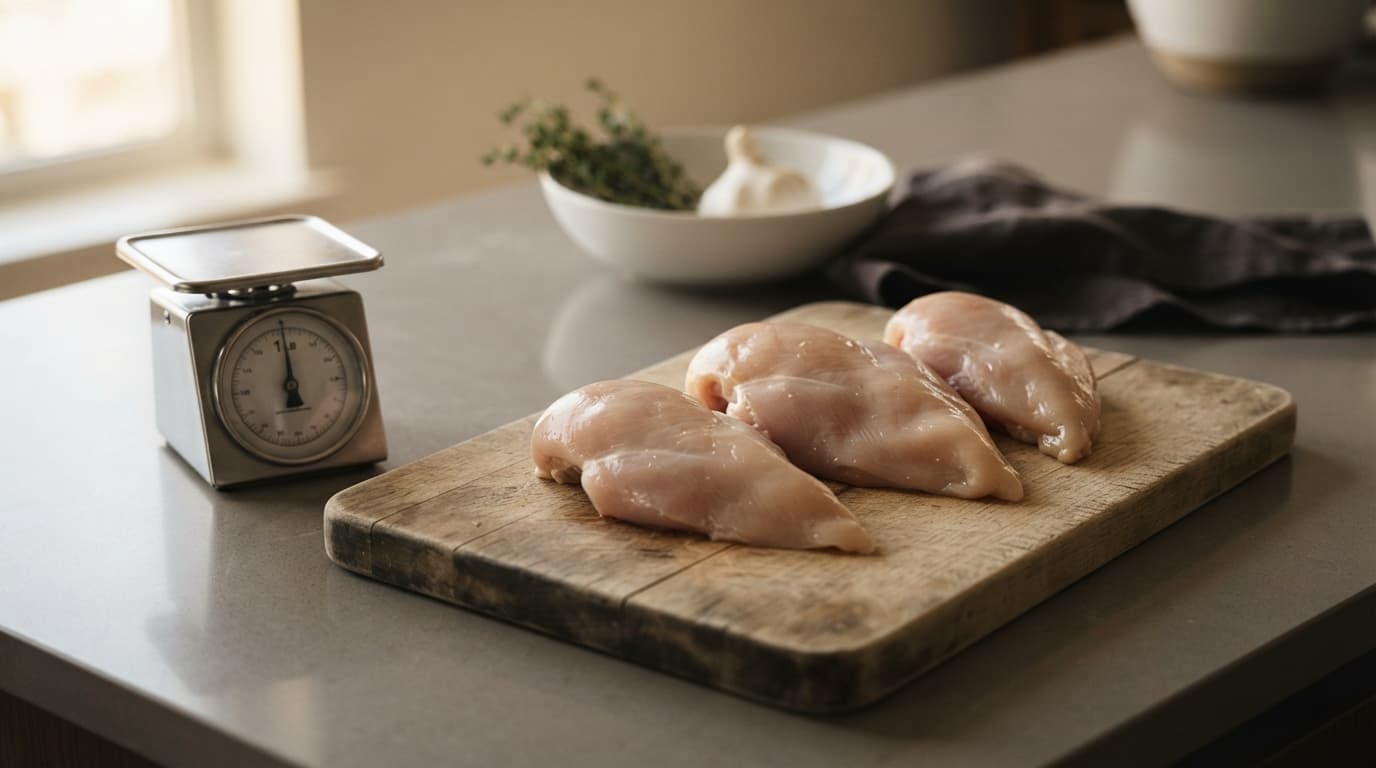
A pound of boneless chicken breast typically holds 2 to 3 pieces, since most breasts weigh 5 to 8 ounces. Size varies enough that weighing beats counting for a recipe.
10 min read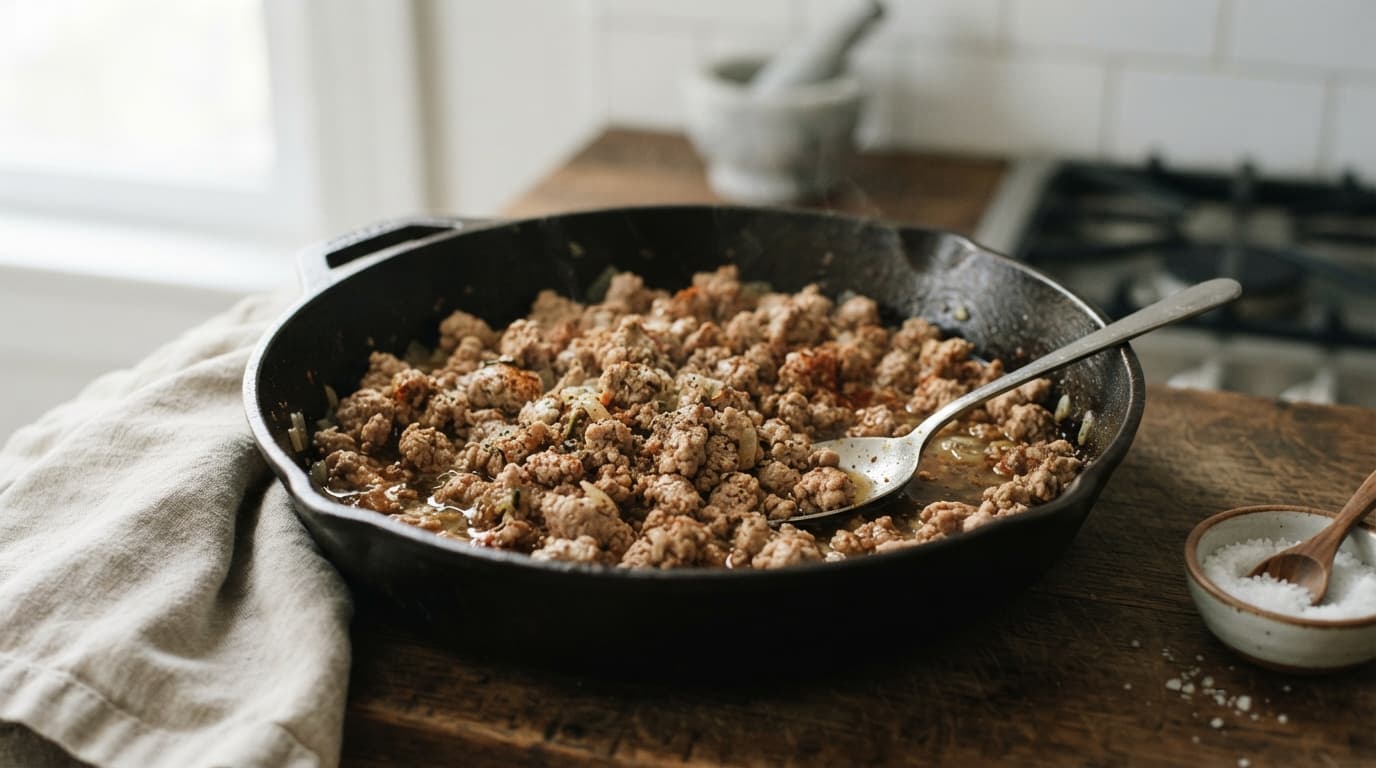
Ground turkey needs about 7 to 10 minutes over medium heat, but time is only a guide. The real requirement is 165°F all the way through, confirmed with a thermometer.
9 min readTables release two weeks out on Resy, Shukette's own booking platform.
Book Now →